CNC Machining Service

Fractory’s CNC machining services will ensure your growing needs never outpace your production capabilities. Our Project Engineers are ready to assist in planning and execution, making certain your projects are completed cost-efficiently and to high-quality standards.

Whether your project is big or small, on the simpler side or highly complex, Fractory can make it happen.

Why Order CNC Machined Parts From Fractory?

  • Scale your production without switching suppliers, we can handle single orders upwards of 2 million pounds.
  • Discuss your CNC machining project with Fractory’s engineers for cost-efficient solutions.
  • Fractory handles everything from quoting to delivery, including quality control.
  • A single point of contact simplifies project management, freeing up time for value-added activities.
  • We orchestrate your entire production path, seamlessly connecting initial machining with finishing and final assembly.
  • Instant quotes and lead times for prototyping and low-volume orders.
Trusted by 62,000+ engineers

CNC Machining Online Quotes

Ordering CNC machining online allows you to get instant quotes for prototyping and low-volume orders under £2000. There are no limitations to the minimum order size.

Just upload your 3D part files onto the platform and select the appropriate properties, including the material, surface roughness and general tolerances and the price and lead time for your custom CNC parts will be updated in real time. After confirming, we take care of the manufacturing side of things, including quality control and delivery.

  • Go to Fractory’s platform.
  • Upload your 3D CAD files onto the platform. Supported formats include STP, SLDPRT and IPT.
  • Select your material and address for an instant price and lead time.
  • We will take care of the delivery, regardless of where you are in the UK.

If you have any questions, turn to our engineers via email.

Get your CNC machining quote in seconds

Instant quote

About CNC Milling Services

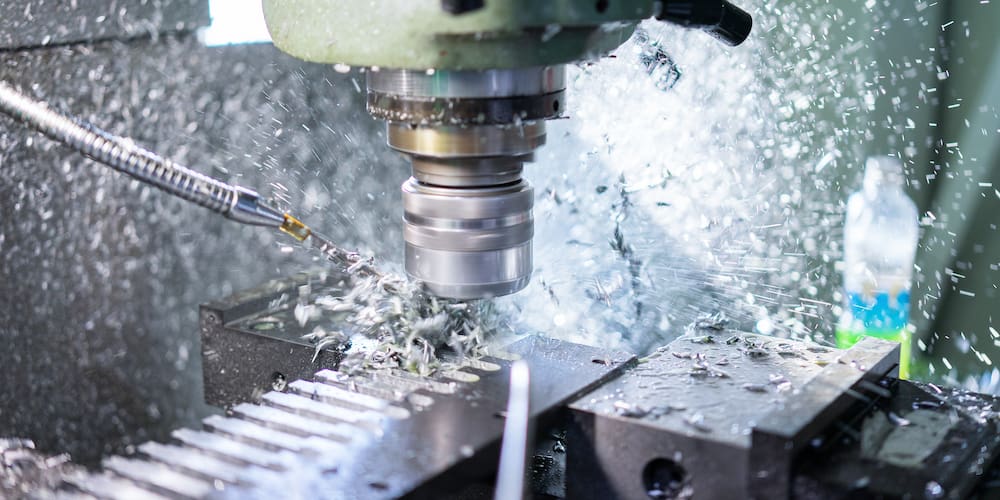
A CNC milling machine performing a grinding operation.

As a core part of our CNC machining services, milling uses rotating tools to remove material from a workpiece. Unlike drilling, which is limited to axial movement, a CNC mill can move both axially and laterally to create complex geometries.

Our CNC milling service offers state-of-the-art precision machining capabilities include 5-axis milling and live tooling. Driven tools significantly reduce production times by performing multiple operations in a single setup without tool changes. This allows us to manufacture high-quality precision components with an outstanding surface finish and tight tolerances.

About CNC Turning Services

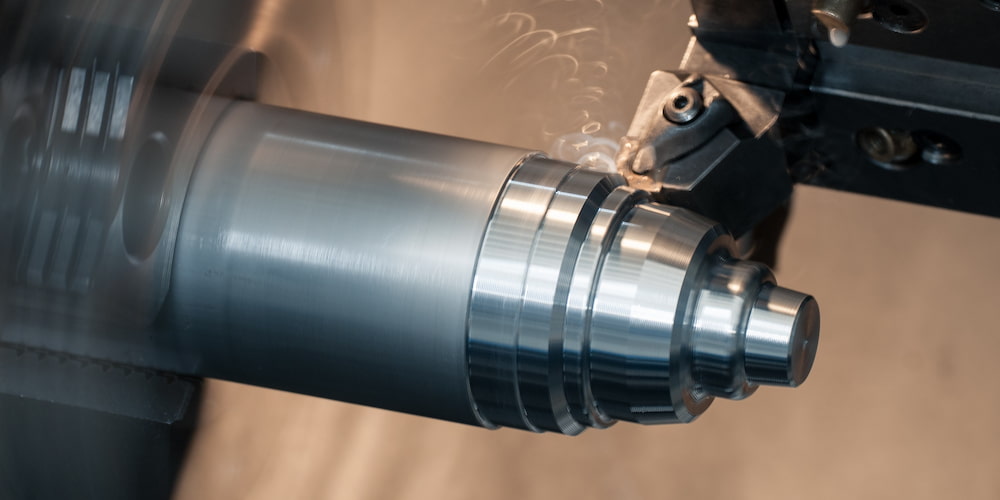
CNC lathe performing a turning operation.

Our CNC turning services are the primary choice for creating cylindrical components, such as shafts. During this process, the workpiece spins while an automated cutting tool moves axially to remove material. Modern CNC lathes and machining centers allow for various operations, including boring and threading, while ensuring near-identical consistency across all parts.

We offer CNC machining for a wide range of materials, including metals (steel, aluminum, titanium) and plastics (nylon, POM, PE), for both prototyping and large-batch manufacturing. To further reduce lead times and costs, we provide sliding head turning, which can be twice as fast as traditional fixed-head machines. Through our extensive partner network, we guarantee the capacity and expertise required for any precision engineering project.

CNC Machining Design Tips

  • Add radiuses to internal edges. Most cutting tools are cylindrical, thus achieving internal sharp edges can be tricky. It’s recommended to have internal radii of 130% of the milling tool radius.

  • Avoid excessively thin walls. Thin features are prone to vibrations and deformations due to heat generated from cutting. This lowers the achievable tolerances.

  • Specify tolerances only where needed. Adding too tight tolerances will drive up the cost. Standard tolerances according to ISO 2768-m will be applied by default.

  • Avoid designing unnecessary features and features that can’t be machined. The same goes for really small features, which would need to be micro-machined. Our partners have micro-machining capabilities but this is an expensive process.

  • Cavities should have the correct depth-to-width ratio: 4 times the width of the cavity. Deeper cavities need to be machined with larger diameter tools resulting in bigger radiuses on internal edges.

  • Limit thread length. 3 times the nominal thread diameter is enough as strong thread connections take place in the first few threads.

  • Design holes with standard sizes, as these can be machined with standard drill bits. Non-standard holes are treated as cavities and machined with an end mill tool.

CNC Prototyping

CNC prototype machining allows the production of highly accurate parts in a relatively short time period. For example, die casting and injection molding require a lot of time and upfront investments and thus aren’t generally preferred for prototyping.

Sheet metal prototypes tend to be more expensive when multiple forming processes are required. It’s quite common that a prototype is created by CNC milling but when the part reaches end production it will be made from sheet metal. This obviously does not mean that CNC machining is not suitable for large-scale production, every part is unique and should be evaluated on a case-by-case basis.

Another reason why CNC metal machining is great for rapid prototyping is that there’s no need for fixed tooling. The metal cutting inserts perform various cutting functions and depending on the CNC machine, these tools are swapped automatically or manually. Either way, time is saved.

Although additive manufacturing is a great option for creating visual prototypes, then in a lot of cases, a functional prototype is needed. CNC rapid prototyping produces parts that match the strength and other mechanical characteristics of the final product.

It is easy to implement small improvements and modifications to the original design with CNC machining. It’s possible to work with a wide variety of metals and plastics allowing to test the performance of a part made from different kinds of raw materials. This helps to find the optimal solution for the end product.

What Is CNC Machining?

CNC machining is a metal fabrication method where written code controls the machinery in the manufacturing process. The abbreviation CNC stands for computer numerical control.

Contemporary CNC machines are fully automated, eliminating the need for a manual operator to directly control the CNC machine. The code determines everything from the movement of the cutting head and the part to spindle speed and RPMs. All they need is digital files with instructions about cutting trajectories and tooling.

The part’s shape and mechanical properties are defined in a CAD file. This information is then turned into manufacturing directives for CAM (computer aided manufacturing) software. Lastly, it is transformed into specific commands for a particular machine and loaded onto the CNC machine.

Although the majority of machining processes in the manufacturing industry are controlled by computers, then in a traditional sense CNC machining refers to only a few of these automated processes, namely milling, turning and drilling.

CNC machining is a subtractive manufacturing method. This means that material gets removed during the production process, making it the opposite of additive manufacturing, e.g. 3D printing.

The benefits of CNC machines include great positioning accuracy and high repeatability, so you get consistent results every time. CNC machining is suitable for both rapid prototyping and high-volume serial production.

To learn more about CNC machining you can find additional CNC machining resources from our engineering blog.

Our Multi-Stage Connected Manufacturing Approach

  • Upload & configure

    Upload & configure

    Simply upload your CAD files, choose your materials and processes, and receive a comprehensive quote for your entire project.

  • Multi-Stage Manufacturing

    Multi-Stage Manufacturing

    Our MSCM platform orchestrates a bespoke production path through our network of manufacturing partners, balancing speed, cost, and quality to meet your project's unique demands.

    • Intelligent planning
      Intelligent planning

      The core of MSCM. Our platform creates a complete production blueprint, mapping the original sequence of processes and identifying specialist partners.

    • Specialist production
      Specialist production

      Core manufacturing processes are routed to the ideal manufacturing partner. On completion, parts undergo rigorous quality checks before moving to the next stage.

    • Partner coordination
      Partner coordination

      Our platform manages all partner logistics and communication, orchestrating the production flow and adapting to real-world situations to eliminate delays.

    • Finishing
      Finishing

      We coordinate all secondary processes, from heat treatments to surface finishes, applying targeted quality checks to ensure they meet your exact requirements.

    • Assembly & kitting
      Assembly & kitting

      We manage the final assembly process. Parts are configured to your required level, from kitted components and sub-assemblies to complete units, ready for final validation.

  • Quality checked & delivered

    Quality checked & delivered

    Your completed parts are checked against your specifications to ensure quality before being packaged for on-time delivery.

CNC Machining Services FAQ

How much does your CNC service cost?

Fractory has developed in-house algorithms and proprietary technology capable of providing automatic pricing for CNC-machined parts. Quotes are based on actual manufacturing logic –  each uploaded file is processed to recognise the manufacturing process and properties of the part, which determine the manufacturing time and cost.

How to reduce the cost of CNC machined parts?

The cost of CNC-machined parts is driven by four primary factors: machining time, material selection, start-up costs, and part geometry. To lower your costs and ensure the manufacturability of your CNC parts:

  • Optimise design: Use our platform to test design iterations and compare prices. Follow our CNC machining design tips above to simplify complex geometries.
  • Leverage volume: Because setup costs are fixed, increasing the quantity of parts significantly reduces the unit price.
  • Smart material selection: Beyond the raw material price, consider machinability. Harder materials require more time, specialised tools and fluids, increasing the total cost of your custom-machined parts.

Do you provide manufacturing consultation?

Yes, business customers can rely on expert advice from our seasoned manufacturing engineers to find the most suitable and cost-efficient solution to manufacture their parts.

Are turning and milling available for wood and plastics?

The material selection includes metals and plastics, including steel, stainless steel, aluminium, titanium, PE, POM, etc. Wood is not currently available but we are looking to add more materials in the future.

What is the quality of the CNC machined parts?

We follow ISO 9001 and EN 10204 standards and all our manufacturing partners have the ISO 9001 quality management system certificate, ensuring their work conforms to specific quality standards. Fractory’s Quality Engineers add an extra layer of safety to the process.

Do you deliver to my address?

Yes, we serve the whole UK, including all the major cities such as London, Glasgow, Birmingham, Liverpool and Bristol, among others. We also deliver to the whole EU.

Let us ease your workload! Order metal fabrication from Fractory and experience the benefits yourself: 1-1 engineering support, payment terms for companies, a single point of contact, competitive pricing, on-time deliveries and quality control.
Get a Quote